)
)
)
AI-led design redefining architecture
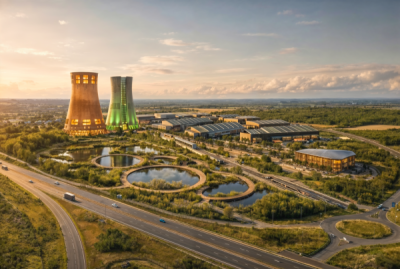
Artificial intelligence is reshaping architectural workflows, enabling adaptive reuse strategies for complex legacy infrastructure assets nationwide.
A rising architectural professional at CPMG is demonstrating how AI-led design can redefine the future of one of the UK’s most recognisable industrial sites. Qasim Iqbal, a 27-year-old architectural assistant and award-winning AI designer, has developed forward-looking concepts for Ratcliffe-on-Soar Power Station, positioning the landmark within the evolving digital construction landscape.
AI-driven adaptive reuseLocated near Nottingham along the A453 corridor, the decommissioned power station has stood empty since September 2024, marking the end of the UK’s 142-year reliance on fossil fuels. Its scale and structural complexity present both a challenge and an opportunity for adaptive reuse in the built environment.
Iqbal’s AI-driven architectural design concepts align with emerging digital construction trends, where computational design, BIM integration, and generative AI workflows are increasingly used to assess redevelopment feasibility. His proposals extend beyond conventional redevelopment models, offering data-informed visualisations that explore alternative futures for brownfield regeneration.
Reimagining infrastructure through AI visualisationResponding to proposals from Rushcliffe Borough Council to enable data centre development via a revised Local Development Order (LDO), Iqbal’s work introduces broader possibilities. His designs explore hybrid-use scenarios, positioning the site as a cultural, educational, and technological hub.
A key feature of the concept is the reuse of the cooling towers as performance venues. Their acoustic properties, already demonstrated through recent live music events, are enhanced through AI-generated spatial modelling. This approach reflects how digital construction tools can unlock latent value within existing infrastructure.
Iqbal explained: “The Ratcliffe-on-Soar power station is an iconic piece of architecture in Nottinghamshire. Using AI, we’ve been able to gain incredible insight on what its future may really look like.
“From the site being used as an educational and performance space, through to hybrid uses to accommodate a cultural or science hub, there are many design avenues to explore for us to see its true potential. As the current consultation focuses on the introduction of new data centres, I’m keen to see how things progress and how true they may be to my AI designs if they are to become reality.”
Sustainable design
Beyond reuse, the proposals incorporate climate-responsive design strategies. Addressing the site’s history of flooding, Iqbal integrates “sponge city” principles, an approach increasingly referenced in sustainable urban design and digital construction modelling.
These concepts combine water retention systems, landscape engineering, and environmental simulation to manage surface water effectively. AI-assisted modelling enables scenario testing at scale, supporting resilient infrastructure planning while enhancing ecological performance.
Iqbal added: “Looking at the wider site, its potential can go even further through AI design, allowing us to open doors that may have been previously locked and understanding new realms of possibility both for this site and what could be possible for other brownfield sites like it across the UK.
“With the support of the team at CPMG, I’ve been able to focus on developing my own AI design skills while also driving company-wide growth by incorporating the best parts of AI into our everyday work, alongside those all-important BIM and traditional design techniques.”
Future of AI in architectureIqbal’s work has gained industry recognition through the International AI Design Awards, where he received both a second-place award and special recognition. This highlights the growing role of AI in architectural design innovation and digital construction methodologies.
Richard Flisher, managing director at CPMG, commented: “Innovation plays an important role in architecture and is something we’re continually exploring at CPMG. With AI opening up new possibilities every day, it’s exciting to see how emerging technologies can support the design process. Seeing how Qasim has used AI to develop ideas into engaging design concepts highlights the talent of the next generation and the fresh perspectives shaping the future of our sector.”
AI-led design, BIM integration, and adaptive reuse strategies are redefining digital construction, positioning legacy infrastructure as valuable assets within future-ready, data-driven built environment ecosystems across the UK.
Source Image/Source: Simon Foulds
London Build is the UK's largest and leading construction show. Featuring 450+ Exhibitors, 900+ Speakers across 17 CPD Conference Stages, 25,000+ Attendees, Networking Parties, Meet the Buyers, DJs, entertainment and so much more. Don’t miss out on free tickets.