)
)
)
Who Constructed The London Eye?
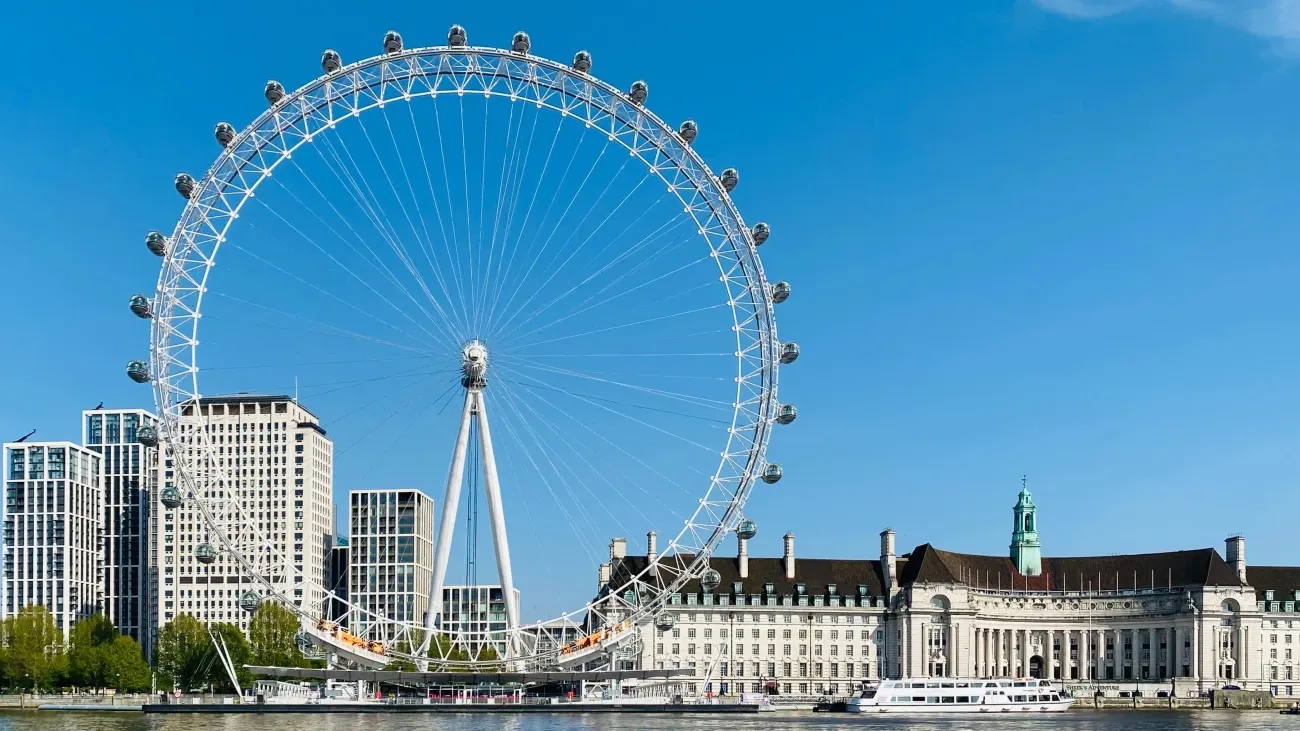
At 135m, The London Eye is the world’s largest cantilevered observation wheel. It was conceived and designed by Marks Barfield Architects and was launched in 2000.
It has won over 85 awards for national and international tourism, outstanding architectural quality and engineering achievement. In fact, it has become the UK’s most popular paid for visitor attraction.
In 2025, The London Eye celebrates its 25th birthday.
The Stats and Figures:
Location: South Bank
Client: The London Eye Company
Cost: £85M
Status: Completed March 2000
Height: 135m
Principal steelwork contractor: Hollandia
Capsule contractor: Poma
Engineer: Jacobs
Construction manager: Mace
What is now called the London Eye originated as an entry submitted by David Marks and Julia Barfield of Marks Barfield Architects in 1993 to a competition sponsored by The Sunday Times and Great Britain’s Architecture Foundation for a new landmark to commemorate the millennium in London. Although no winner was declared, Marks and Barfield undertook the development of the project themselves and found the site where the wheel now stands. Much of the funding was provided by British Airways. Construction began in 1998, and the wheel was put together over the river in a horizontal position before being pulled upright. The London Eye, as it was called by this time, was ceremonially opened by Prime Minister Tony Blair on December 31, 1999, but did not admit its first paying passenger until March 9, 2000. Originally scheduled to be dismantled after five years, it was kept in place because of continued popularity. In 2006, a decorative LED lighting system was installed to make the wheel more prominent after dark.
The hub of the wheel rests on two supports, which are anchored to a foundation on the riverbank and lean out over the river at an angle of 65 degrees from the horizontal. With both its supports on the same side of the hub, the wheel is said to be cantilevered over the river. The entirety of the structure is held in place by six backstay cables anchored to a second foundation.
The wheel itself has a diameter of 394 feet (120 metres) and is connected to its hub by 64 cables that function much like the spokes of a bicycle wheel. The power to turn the wheel is transmitted to the rim through rubber tires mounted on the base of the structure. Mounted on the wheel are 32 ovoid capsules, as the cabins that carry the passengers are called. Their number corresponds to the 32 boroughs that, together with the City of London, constitute Greater London. Each capsule has a capacity of 25 passengers and rests on motorized mounts that function in such a way that the capsule remains upright as the wheel turns. The wheel moves so slowly—two revolutions per hour—that it need not stop for boarding or disembarkation of passengers, except for those with disabilities.
The London Eye’s original owners were British Airways, Marks Barfield, and the Tussauds Group. Tussauds became the sole owner in 2006. The following year, Tussauds was sold to the Blackstone Group, a private equity firm that folded the London Eye into its Merlin Entertainments Group.
Sources: London Eye, Britannica, Marks Barfield Architects
London Build is the UK's largest and leading construction show. Featuring 450+ Exhibitors, 750+ Speakers across 12 CPD Conference Stages, 38,000+ Registered Attendees, 20+ Networking Parties, Meet the Buyers, DJs, entertainment and so much more. Don’t miss out on free tickets. Register now