)
)
)
The Digital Handshake: Defining the Minimum Data Handover Requirement to Plug the Project-Operations Gap
From Diagnosis to Execution
Over the last two years, I have had the privilege of partnering with London Build Expo under a couple of different hats to bring one of the built environment's most critical challenges to the fore.
In 2024, under the banner of the Digital Buildings Council, we focused on diagnosing the fundamental disconnect between capital project delivery and long-term facility management, often referred to as the project-operations gap.
Last year, with my Start With Smart Group, I moderated two standing-room-only panels that examined both the root causes of that gap and the reality of artificial intelligence. Those discussions validated a critical operational benchmark. In short, true asset value and 80 to 90 per cent of whole-life building costs reside in the sixty-plus years of operations rather than the short three-to-five-year design and build window. Furthermore, we demonstrated that real AI return on investment is already happening on the operational frontline, such as Sodexo using AI to automate routine maintenance workflows, including statutory logging in hospitals, saving engineers up to four hours of manual admin every day.
This November, I am back again partnering with London Build Expo under the Start With Smart Group banner.
What has become glaringly obvious through my direct engagement with asset owners, operators, and occupiers throughout 2026 is a growing market realisation. Plugging the project-operations gap cannot be achieved by attempting to force left-to-right project compliance through information management into operational estates alone. Doing so can far too easily end up treating handover as a linear compliance dump rather than supporting the ongoing operational reality once a building is in use.
What institutional leaders are increasingly telling me is that treating handover as an isolated technical file drop risks underdelivering on operational potential. Facilities management and operational technology are increasingly expected to align with the overarching business goals set by owners, occupiers, and operators.
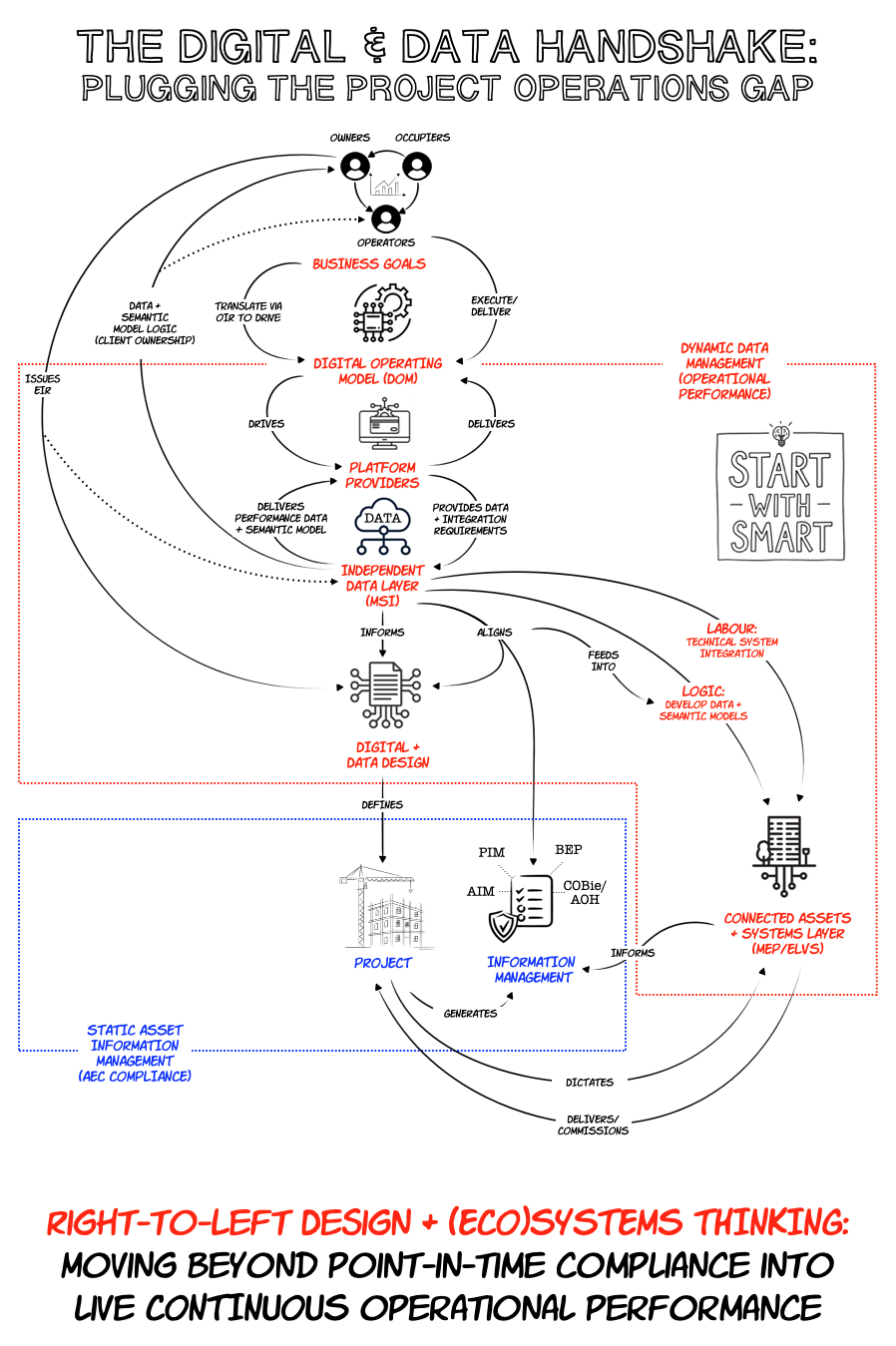
That is why progressive voices across the sector are advocating for genuine right-to-left design thinking. That means working backward from overall business goals, translating them via Organisational Information Requirements to define the Digital Operating Model, and only then configuring the platforms, frontline workflows, and data plumbing required to execute those outcomes.
At the very centre of this shift lies the Digital Handshake. This is far more than a routine handover file or an administrative box ticked at RIBA Stage 6. It is the critical interface where static project records must transition into dynamic, living operational data that proves the asset is actually delivering on its business case. That digital handshake and the technical, commercial, and operational mechanics required to make it survive are precisely what our panel will address this year.
The Methodology Clash: Linear AEC versus Circular Operations
To understand why traditional handovers fail so predictably, we must look at a fundamental clash of methodologies between how buildings are constructed and how they are operated.
The architecture, engineering, and construction sector operates on a linear, point-in-time delivery process. It moves sequentially through design and construction, culminating at Practical Completion. Once the build is handed over, the project team secures payment and exits. This helps explain why many on the operations side view information management as little more than a compliance shield, designed to ensure sign-off and payment go ahead rather than serving long-term operational performance.
Building operations, by contrast, is an inherently circular, continuous loop lasting over sixty years.
Initiatives like the ADS Alliance offer a valuable re-evaluation of this boundary, advocating that RIBA Stage 6 should be viewed not as a traditional construction endpoint, but as the active start of operations, a genuine Soft Launch. From there, the operational lifecycle is structured into three phases, namely Stage 7A (Maintain), Stage 7B (Optimise), and Stage 7C (Renew).
On paper, this operational model can be mapped directly onto a classic Plan-Do-Check-Act quality cycle. Stage 6 (Soft Launch) acts as the Plan phase, where business goals and Organisational Information Requirements are set before full occupancy, or at the beginning of new projects in existing estates such as a retrofit, refurbishment, or refresh. Stage 7A (Maintain) represents the Do phase, executing daily maintenance routines and statutory compliance. Stage 7B (Optimise) serves as the Check phase, using live operational telemetry from building management systems, edge sensors, and energy analytics. Stage 7C (Renew) forms the Act phase, covering capital replacement planning and long-term estate reinvestment.
However, when examining how estates are now operating on the ground as a result of digital operations, two key distinctions emerge between a theoretical framework and daily operational reality.
First, while a theoretical model presents 7A (Maintain) and 7B (Optimise) as consecutive steps, in real-world operations they run in parallel. Stage 7B operates continuously in the digital domain, where processes such as energy optimisation can occur autonomously without requiring human intervention. Stage 7A, by contrast, relies on physical human action, whether servicing an asset or responding to a maintenance call on site.
Second, there is a common view within facilities management that smart building technologies are simply a subset of traditional operations. Theoretically, that might appear true, but in practice, it risks overlooking operational realities on the ground. Configuring operational technology, IP networks, BMS protocols, and semantic data models is a specialised integration discipline. Furthermore, given the widespread skills shortages across facilities management, onsite teams do not always possess the technical capabilities required to run and manage those complex platforms day-to-day. Treating this space as a mere subset of facilities management ignores the reality of both technical systems integration and daily platform operation.
This raises an important canvas question for our industry. Should the smart buildings space, across both integration and ongoing platform operation, actually be recognised as a distinct domain in its own right, working alongside traditional facilities management rather than being subsumed by it?
Where these operational tracks meet is where Smart FM happens. As technology advances across different parts of operations, moving from seasonal commissioning to continuous monitoring-based commissioning, and shifting towards data-led rather than calendar-led maintenance, it fundamentally challenges how these parallel functions work together.
Crucially, asking how these operational domains collide and how much their frameworks will change is not an academic exercise. It directly impacts what minimum actually means when defining a minimum data handover requirement. If operational validation and maintenance become continuous and data-led across distinct technical integration and operational roles, the baseline data and digital architecture required at handover fundamentally change.
This sets up a central theme for our panel during The Digital Handshake session, exploring how these distinct operational domains and evolving requirements redefine the true minimum data handover baseline needed to make the project-operations transition work in practice.
Defining the Baseline: Framework Alignment, Policy Drivers, and Commercial Teeth
To define a workable minimum data handover requirement, we must look at how operational standards, policy, and commercial contracts interact across the building lifecycle.
The primary strength of the ADS Alliance is its focus on cross-working and aligning the standards and classifications already embedded in industry practice. Rather than creating new abstract models, it maps the tools used across specific lifecycle stages, including Uniclass at Stage 6, SFG20 and CIBSE Guide M for maintenance at Stage 7A, and NRM3 for capital replacement at Stage 7C.
While this alignment work is vital, voluntary market adoption of industry frameworks and standards often faces significant inertia. This is where policy becomes critical. By using these aligned frameworks to inform public sector policy and procurement standards, such as the Government's mandatory FM002 Asset Management for FM standard, top-down policy mandates can help drive wider market adoption.
However, a critical distinction must be made between process standards and genuine business governance. Process standards like ISO 19650 standardise the information management conveyor belt, such as folder naming conventions within a common data environment. They standardise the packaging, not the asset itself. Genuine management standards like ISO 55001 are business governance frameworks that dictate how human beings make real decisions based on risk and financial accountability. Confusing a technical packaging standard with a management philosophy gives asset owners the false impression that a compliant file automatically equals a well-managed building.
Further evaluating this policy and standards landscape reveals a major gap in current alignment efforts, where two missing pieces may actually be two sides of the same coin.
While Stage 7A (Maintain) and Stage 7C (Renew) have established frameworks like SFG20 and NRM3, there is no equivalent operational framework for Stage 7B (Optimise). Stage 7B is the fast-moving space where real market innovation is happening, driven by operational technology and artificial intelligence to deliver continuous energy reduction, occupant experience, and genuine asset value.
The flip side of Stage 7B is commercial enforcement. Policy guidance alone sets the direction, but how much do we also need top-down commercial mechanisms, such as performance-related contracts enforced by asset owners?
I ask this because Stage 7B and performance outcomes appear intrinsically linked. The point being, can you enforce performance outcomes without the live data architecture of Stage 7B, and will 7B data actually be delivered at handover without commercial obligation?
This raises a fundamental question for our panel regarding what "minimum" actually means.
Without Stage 7B telemetry linked to operational performance goals, does the minimum data requirement simply default back to a static asset register structured just enough to feed 7A maintenance and 7C renewals?
Conversely, if performance-related targets are written into handover expectations, how radically does that change what the non-negotiable minimum data baseline must be on Day 1?
Schema Evolution: The Next Horizon for Alignment
With the ADS Alliance already joining the dots between Uniclass, SFG20, CIBSE Guide M, and NRM3, the logical next step for that alignment work is how data is packaged for exchange at the Stage 6 boundary itself. This brings buildingSMART’s evolution of COBie into the Asset Operation Handover (AOH) schema directly into focus.
Because COBie and its proposed Asset Operation Handover schema replacement are inherently about information management, this exchange schema represents an obvious area for the ADS Alliance to look at next. From there, the dots connect directly to nima's Information Management Initiative (IMI) and on to the ISO 19650 standard. This is where the Digital Operations Working Group co-led by Steven Boyd MBE comes in. Their strategic collaboration with nima to help support the full life cycle aims and ambitions of the ISO 19650, creates a clear theoretical link between estate asset management strategy, facilities management and practical handover schemas.
This brings three key perspectives to our panel:
- Alex Plenty, Head of Digital Delivery at Skanska and leading the Asset Operation Handover evolution for buildingSMART.
- Steven Boyd MBE, former CEO of the Government Property Agency, co-leading the ADS Alliance and the Digital Operations Working Group.
- Joanna Harris, UK&I Head of Technical Services at Sodexo and lead author of CIBSE Guide M.
It will be interesting to hear whether mapping the upcoming Asset Operation Handover schema inadvertently clarifies the boundaries of information management when it comes to plugging the project-operations gap. At the same time, it may also highlight a broader challenge, because the wider information management establishment can frequently suffer from a form of what can be seen as a linguistic overclaim. That is because the use of the term standard can elevate technical data schemas, which are ultimately just syntax rules defining where data columns go, to appearing to be complete management philosophies.
So even if this upcoming data schema does successfully deliver a machine-readable static asset record at handover, whether as an exchange file or imported into a relational platform, it remains unclear if and how it is expected to handle live operational telemetry, or if that is even its purpose.
Such a framework may still prove highly useful, not least as a more advanced compliance shield for main contractors at practical completion. However, because there is currently no established industry framework for Stage 7B (Optimise) for the ADS Alliance to map onto, performance data remains a notable missing piece. The closest the industry gets is a metric like the NABERS rating, but that is a performance score, not an operational data standard or framework. Meanwhile, operators deploying autonomous artificial intelligence platforms are delivering up to fifty per cent energy drops by plugging directly into live telemetry, often without ever needing to know what IFC and COBie mean and are for.
With Joanna Harris on the panel representing Sodexo and CIBSE Guide M, we must question how a purely static focus helps frontline operations in the long term, or if the industry is just hoping for the best. Furthermore, how does the sector plan to prevent immediate data degradation? Without strict data quality governance, the kind seen in corporate enterprise environments utilising ISO 8000 or DAMA-DMBOK frameworks, a static handover file risks becoming a data museum within the first 45 days as onsite parts are swapped out and records are left un-updated.
These unresolved questions mean we need another distinct voice at the table to discuss the Digital Handshake. If standardising the handover data is only one side of the coin, then addressing the performance piece requires looking past exchange files to how operational technology, device naming, and equipment relationships are physically tied together on site. This brings our fourth panellist, John Clark, into the conversation to address the critical, evolving role of the Master Systems Integrator.
The Integration Reality: Platform Orchestration and AI-Ready Data
While industry bodies and working groups focus on aligning frameworks and standards at a strategic level, the Master Systems Integrator performs that alignment practically on site. They operate at the exact boundary where disparate project documentation collides, reconciling conflicting requirements between the main contractor's BIM Execution Plan, the owner's information requirements, design specifications, and asset data. In practice, these rarely match. For example, where an integrator is provided with a design specification that mandates a semantic ontology like Brick, but where the drawings from that same design consultancy use an entirely different convention. Resolving these contradictions on the ground gives the integrator a unique perspective on what cross-framework alignment actually requires.
Initially sitting directly at the Stage 6 handover boundary, the integrator operates across two interconnected tracks. First, they manage the physical integration logic of Extra Low Voltage packages, edge devices, gateways, and MEP systems to establish network connectivity and protocol control. Second, they deploy and configure the physical and digital infrastructure that forms the Independent Data Layer, so that a client-owned Independent Data Model can be hosted on premises and/or in the cloud.
This Independent Data Layer provides a vendor-neutral repository for streaming estate data. Its function is to ensure data is served in the precise format required by downstream software, whether the client chooses a single all-in-one platform or a best-of-breed stack of specialist technologies for smart building orchestration, workplace experience, or data-led predictive maintenance. By decoupling the data from proprietary hardware, the asset owner retains full control over their operational stack, which helps reduce the risk of vendor lock-in.
Crucially, this is where existing information management appears to reach its limit. Because the information management community is predominantly drawn from project delivery, practitioners rarely have first-hand Day 2 operational experience, particularly regarding the real-time integration requirements of operational software platforms.
This makes semantic modelling a critical, specialised discipline that falls directly to the integrator. Because when they possess that essential Day 2 understanding, the Master Systems Integrator knows exactly how downstream platforms will consume the data. As these systems become increasingly AI-enabled, executing this semantic modelling is what provides the essential operational context.
Artificial intelligence cannot optimise a building or diagnose faults without explicit relationship modelling, knowing which sensor monitors which asset, how air handling units relate to downstream terminal boxes, and what static equipment serves each physical spatial zone.
By actively building this semantic model across isolated operational technology packages, the Master Systems Integrator delivers the structured, high-integrity data pipeline required for operational AI to perform.
Navigating Complexity: The Digital Handshake Debate
What I have sought to outline here is that the Digital Handshake is not a simple administrative transaction, nor can it be solved by any single discipline in isolation. It represents a complex, multi-layered transition that moves far beyond the static handover of traditional asset registers.
That complexity is precisely why we have brought together panel leaders representing every critical facet of this ecosystem, spanning estate asset management strategy, national information management frameworks, frontline facilities management, and hands-on operational technology integration.
As technology advances at an unprecedented pace, not least with the push to deliver or retrofit AI-ready building portfolios, this multi-disciplinary panel sets out to tackle a fundamental question. Is it even possible to establish a truly non-negotiable minimum data handover requirement, given that minimum means something radically different depending on who you ask?
Can such a baseline ever be achieved across these conflicting disciplines? If so, what would it actually look like in practice, and who ultimately gets to define it?
“Our ongoing partnership with Justin and Start With Smart has led to some of the most thought-provoking discussions at London Build. The best panel sessions don't just share ideas; they spark conversations that continue long after our event. We're proud to provide a platform for Justin and his expert panel to do just that and are delighted to welcome the them back on November 25th to continue this vital industry discussion.” - Carlie Hedmann, Head of Production - London Build
Please come and join us this November and become part of the conversation.