


Dowds Forum Challenges Construction to Rethink the Future
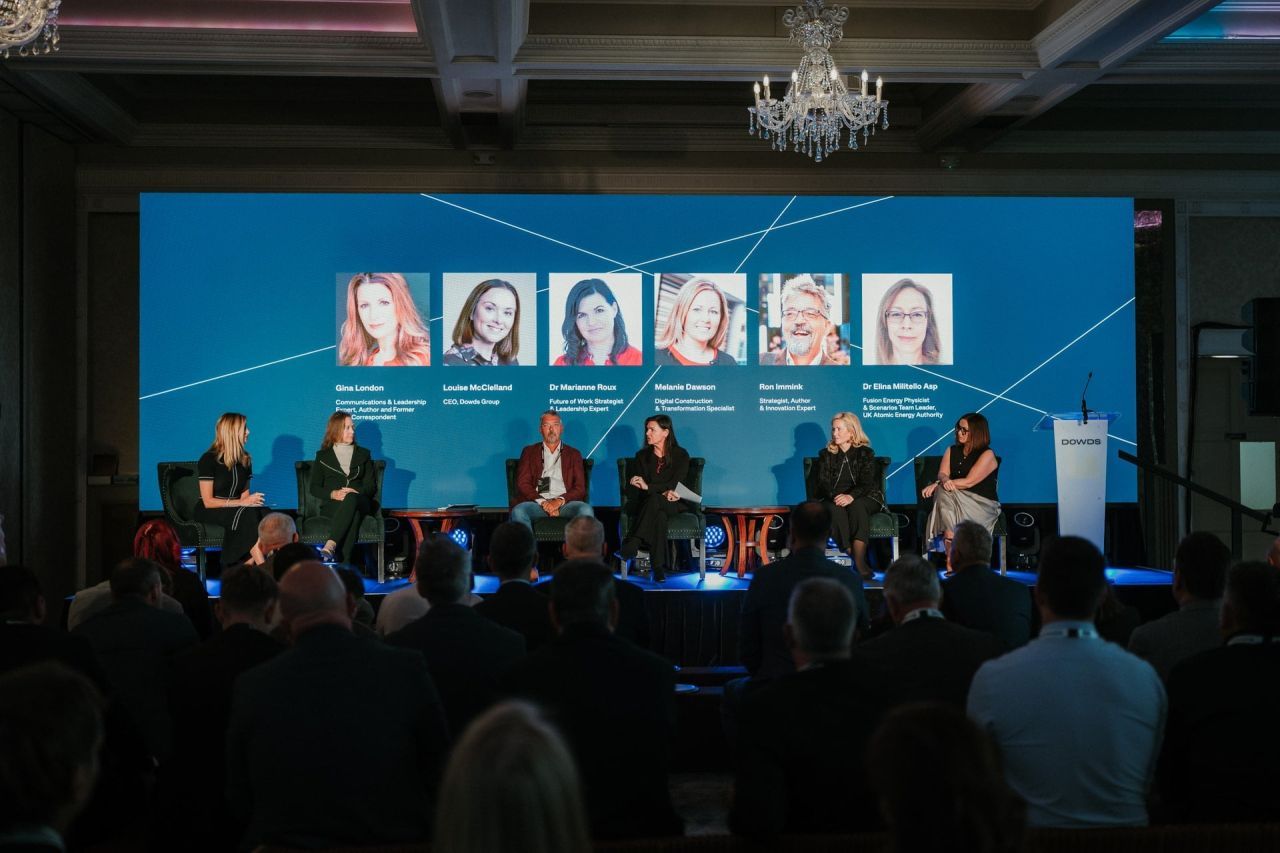
The Dowds Forum brought together more than 100 of the most influential voices from construction, business and academia to explore a fundamental question: how can the UK’s built environment take greater responsibility for the future it creates?
The construction and engineering industries are no strangers to conversations about transformation. Yet, despite the growing influence of AI, mounting skills pressures and increasingly ambitious sustainability targets, one challenge remains: how do businesses turn their appetite for change into meaningful action?
This question was central to the inaugural Dowds Forum, held on the 8th of October at the Culloden Estate & Spa in Belfast.
Under the theme “The Environments We Create”, the event brought together thought leaders from across the industry and beyond, to explore the forces shaping construction and engineering's future.
Dowds Group CEO Louise McClelland opened the forum and set the tone for the day, encouraging attendees to challenge established thinking and consider the wider impact of their decisions.
Her speech reflected Dowds' ambition to be not necessarily the biggest, but the best, with quality and integrity taking precedence over scale alone. She also carried a warning: businesses that stand still risk being left behind.
Creating the conditions for changeThe forum's central theme extended beyond the buildings delivered by construction and engineering businesses, challenging attendees to consider the cultures and working environments they create along the way.
An accompanying exhibition explored four pillars of Dowds' business strategy: People and Pathways, Innovation in the Built Environment, Operational Excellence and Responsible Growth and ESG.
Across four dedicated exhibition zones, Dowds showcased how it is putting these priorities into practice, from developing talent and embracing digital innovation to strengthening delivery standards and embedding sustainability across its projects.
The exhibition was designed to spark conversation rather than simply showcase the business. Displays challenges attendees to share their thoughts, with questions such as: "The industry is losing experienced workers faster than it can replace them. How are we going to solve this?"
These questions reflected the pressures facing construction businesses: delivering complex projects, maintaining commercial performance, attracting talent and keeping pace with technological change.
The question is no longer simply whether companies recognise these pressures but whether their leadership structures and working cultures are equipped to respond.
For McClelland, who joined Dowds seven years ago and served as Executive Director before becoming CEO in 2025, creating an environment where people, partnerships and projects can thrive remains central to her leadership approach.
This perspective took centre stage during the forum's keynote panel discussion, which explored the future of work and leadership.
The future workforce: looking beyond traditional talent pipelinesOne of the panel's strongest messages was that the construction industry’s skills challenge cannot be solved simply by recruiting more people into existing roles.
Moderated by former CNN correspondent Gina London, the discussion brought together Louise McClelland, future-of-work strategist Dr Marianne Roux, digital construction specialist Melanie Dawson, innovation expert Ron Immink and Dr Elina Militello Asp of the UK Atomic Energy Authority.
Dr Militello Asp challenged businesses to think strategically about maintaining and developing existing skills, while McClelland questioned how organisations could attract the right people before demand becomes critical.
For Dowds, this means looking beyond traditional construction pathways and recognising the potential of professionals from outside disciplines including chemical engineering, nuclear engineering and data engineering.
Yet attracting new talent is only part of the equation.
Dawson argued that leaders must shout out about their organisation's ambitions more effectively, demonstrating to potential employees that they are forward-thinking and willing to embrace change. Roux reinforced this, emphasising that workplace culture is shaped by leaders, rather than something that can simply be delegated to HR departments.
Dawson also highlighted an opportunity to bridge construction's generational divide, combining younger workers' digital skills with the practical knowledge of experienced professionals. She highlighted that bringing both generations together could create valuable opportunities to learn from one another.
AI, innovation and the freedom to failIf securing the future workforce was one challenge, keeping pace with the relentless advance of artificial intelligence was another.
For Dawson, the message was simply: "AI is no longer an option; this is coming."
She described AI as one of construction's most significant shifts in recent history, arguing that businesses willing to embrace it would benefit most.
But the panel moved beyond technology to question the cultural barriers preventing innovation.
With tight budgets, demanding deadlines and little room for error, construction has often favoured tried-and-tested methods over experimentation.
Immink challenged this mindset by proposing a dedicated 'failure fund'; an allocated budget allowing businesses to experiment and learn from unsuccessful attempts without treating every setback as a commercial failure.
McClelland shared a practical example from Dowds, describing its 'miss-take' sessions that run across their sites, where employees are asked to share recent mistakes, so colleagues can benefit from the lessons learned.
The idea is simple: take the fear out of getting things wrong and turn mistakes into opportunities to improve.
But how does this work in industries where mistakes can have serious safety implications?
Drawing on her experience in fusion energy, Dr Militello Asp explained that experimentation and safety do not need to clash as priorities. Mistakes can be encouraged within controlled environments, provided organisations establish clear boundaries and a culture of psychological safety.
Creating a culture where people feel comfortable speaking up takes more than good intentions. Employees must know they can question decisions and make mistakes without fear of being reprimanded.
Dawson encouraged leaders to ask their teams for a range of possible solutions rather than finding one 'right' answer, keeping them thinking ‘outside of the box’ and learning from one another constantly.
Adopting new technology is one thing. Creating workplaces where people confidently embrace change is a much bigger task.
From competition to collaborationAnother recurring theme was the need to reconsider how knowledge and innovation are shared across the built environment.
Dawson questioned the construction industry’s reluctance to collaborate, observing that firms often hesitate to share solutions in case they give away their competitive advantage or USP.
She also asked Northern Ireland's built environment sector to be louder in terms of shouting about its achievements more confidently, arguing that regional expertise often goes unrecognised because businesses aren't doing enough to showcase their successes.
Immink encouraged attendees to look further ahead into the future, highlighting the emerging bioeconomy and the possibility of one day growing buildings from materials such as mushrooms, challenging conventional thinking about construction.
He also explored how AI could improve transparency and accountability, such as creating the potential to trace pollutants through supply chains.
Yet many of construction's biggest challenges - from decarbonisation to digital transformation - are too complex for any one organisation to solve alone.
For contractors and developers, ambitious sustainability targets are no longer enough. Progress means backing commitments with measurable results and rethinking how projects are designed, sourced and delivered.
Putting people at the centre of progressFor all the talk of new technologies and innovation, the panel kept returning to one thing: people are still at the heart of it all.
Roux urged organisations to prioritise human agency, giving individuals greater ownership over their working environments.
Dr Militello Asp highlighted critical thinking and self-awareness, while Immink encouraged leaders to remain curious and the importance of being able to "learn to unlearn".
London summed that panel up, but stating, “We are at the inflection of a human renaissance."
The message wasn't that technology should be resisted but that its successful adoption depends on the people using it.
The forum continued into the evening with a drinks reception and dinner, before designer and entrepreneur Wayne Hemingway MBE joined London for a fireside chat, sharing stories from his career and the successes and setbacks that shaped his journey.
Turning conversation into meaningful actionThe Dowds Forum tackled some of the industry's biggest challenges, from the short-term pressures to the longer-term changes shaping its future. Across the discussions, one clear message stood out: real progress depends on businesses challenging convention and turning ambition into action.
Reflecting on the event, McClelland said:
"The Dowds Forum exceeded our expectations, not only in the calibre of the speakers and discussions, but in the extraordinary openness, generosity and ambition of everyone who contributed.
Construction and engineering are often perceived as industries resistant to change, yet what we witnessed was quite the opposite. Across People, Innovation, Delivery Excellence and Sustainability, there was a genuine willingness to share experiences, challenge established thinking and seek solutions to the issues shaping our collective future.
'The Environments We Create' was more than a theme for the day. It speaks to our responsibility to shape the environments in which people, businesses and communities can thrive.
The ambition and appetite for progress are already there. What matters now is having the courage to differentiate through action, challenge convention and recognise the far-reaching impact of the choices we make. Our responsibility is to translate the conversations started at the Forum into meaningful progress, not just for our industry, but for wider society."
The inaugural Dowds Forum created a platform for conversation, laying the foundations for new ideas and meaningful progress across the industry. However, the real opportunity lies in what the industry chooses to do next.