)
)
)
Khan reveals tiered affordability thresholds and 558,000-home target in draft London Plan
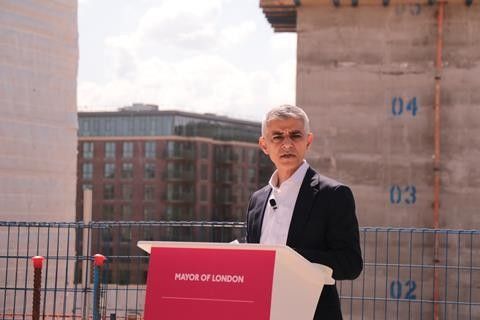
The plan, published by Sadiq Khan in July, aims to increase housing delivery while responding to the viability challenges facing developers across London.
The proposed housing target works out at around 56,000 homes a year, with more than 500,000 of the homes expected to come forward on brownfield land. The plan also sets out longer-term ambitions to build towards the Government’s identified housing need of around 850,000 homes.
New affordable housing thresholds
One of the biggest changes for developers is the proposed overhaul of London's affordable housing threshold approach.
Instead of applying one standard threshold across the capital, the Draft London Plan introduces different requirements depending on location and the type of land being developed.
For schemes using the fast-track planning route, the proposed thresholds are 35% in higher-value areas, 25% in the second band and 20% in the third.
Higher requirements would apply to certain types of land, with a 50% affordable housing threshold for Green Belt development, 40% for public sector land and 35% for industrial land.
The Mayor's longer-term ambition remains for 50% of homes delivered in London to be genuinely affordable.
The latest figures in the Draft London Plan identify a need for around 238,430 low-cost-rent homes and 129,020 intermediate homes by 2037.
The tiered approach is designed to take account of differences in land values, development costs and viability across London. Developers meeting the relevant affordable housing threshold can also benefit from the fast-track planning route, avoiding lengthy viability negotiations and potentially speeding up the planning process.
Brownfield first, but Green Belt development on the table
Brownfield land remains at the heart of the Mayor's housing strategy, with the plan identifying more than 500,000 homes of its ten-year target as brownfield capacity.
However, the Draft London Plan also identifies locations where Green Belt land could be released for housing, particularly where development can be supported by good transport connections.
This could create new opportunities for developers and contractors, while also putting greater focus on the infrastructure needed to support new communities.
What does it mean for London's construction industry?
The scale of the proposed housing target could create a significant pipeline of work across London's construction sector, from housebuilding and affordable housing through to infrastructure, planning, architecture and building services.
But the challenge will be turning planning capacity into homes actually being built.
The Draft London Plan recognises that viability, infrastructure capacity and the wider economic environment will all affect how quickly projects can move forward.
The consultation is now open and closes on 15 October 2026, giving developers, contractors, architects, planners and other industry professionals the opportunity to respond to the proposals.
With London continuing to face significant housing pressures, the new plan could play a major role in shaping the capital's construction pipeline over the next decade.
Read more here https://www.theguardian.com/uk-news/2026/aug/04/brick-lane-redevelopment-approval-datacentre-london