)
)
)
Speaker Spotlight: Audley English MBE

What first inspired you to pursue a career in architecture and construction and how has your journey in the industry evolved?
My father was a road gang foreman in Jamaica, but he died when I was young. My family subsequently immigrated to the UK, and I grew up as a second-generation Windrush descendant.
I remember being 12 years old when I woke up one morning and told my mum, “I want to be an architect, following Dad into construction.”
My careers adviser told me that this was unlikely and suggested that I should become a joiner instead.
I left school and secured one of eight apprenticeship places with George Wimpey the UK's leading housebuilders on its four-year Architectural Technician training programme. I worked within the design team, designing projects using the Wimpey No-Fines system a rapid construction system developed by George Wimpey and widely used for housing from the 1940s through to the 1970s.
I then won a scholarship to study architecture full-time at the world’s most prestigious school of architecture, the Architectural Association. Once qualified, I became the UK’s first West Indian architect, and in 1984 I established the UK’s first Black-led architectural practice.
Your panel at London Build 2026 is discussing “Building Better Together”. What does that mean to you, particularly when it comes to collaboration between architects, contractors and clients?
Coming from a minority background, I have seen first‑hand the benefits of collaboration. As an architect leading project delivery, I have always focused on maintaining the project objectives, keeping the project within budget and ensuring completion is achieved as planned.
For me, team honesty is essential, as is keeping an open dialogue between everyone involved in the project. Problems need to be addressed rather than avoided or pushed aside. Effective collaboration means being open about challenges throughout the project, avoiding a blame culture, addressing issues together and taking responsibility for achieving the right outcome.
Too often, at handover, past problems can seem insignificant once the project has been completed, with the focus shifting to agreeing the final contract sum and everyone moving on. That is why continuous collaboration and open, honest communication throughout the project are so important.
Having worked across design, project management and delivery, where do you think collaboration most commonly breaks down?
My architectural practice introduced the first use of Construction Management on a government housing project in 1991, with each package contractor contracted directly to the client rather than being paid through a main contractor. The project was delivered six months ahead of programme and 15% under the contract value.
Across many forms of contract, the recurring failure is the procurement route chosen. Contracts are routinely rewritten to favour the client or the main contractor, and this is reinforced by a culture of delayed payment. Subcontractors are pushed to price at the bare minimum to stay competitive, operating on wafer‑thin margins while being driven to deliver at speed. Quality inevitably suffers, in and out as fast as possible, often with little regard for the work of other trades. Many then wait 60–90 days for payment, creating a damaging ripple effect throughout the entire supply chain.
With the UK facing significant housing delivery targets, what role can MMC play in helping the industry deliver homes faster without compromising on quality?
Having acted as both Principal Designer and Principal Contractor, I delivered a social housing council project using an MMC kit-of-parts. The project has remained defect-free since its handover in 2020, demonstrating what can be achieved through the use of MMC when it is properly designed, coordinated and delivered.
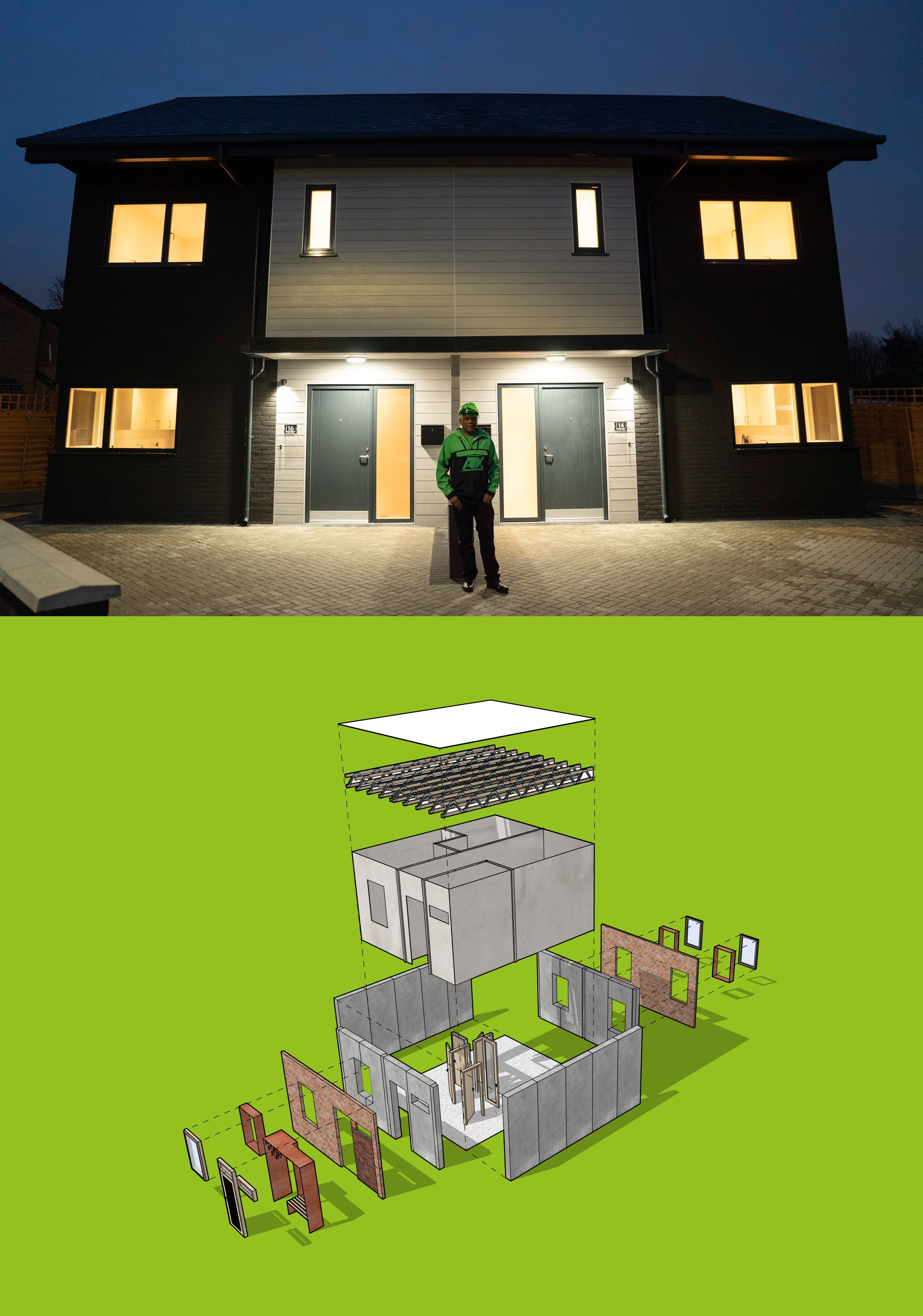
Industrialised Construction Platform DfMA Kit‑of‑Parts for Social Rent, completed in 2020 — remains defect‑free to this day.
What role should SMEs play in tackling the UK’s housing challenges and what needs to change to make it easier for innovative smaller businesses to contribute?
SME housebuilders once built around 40% of new homes in the late 1980s, whereas today they account for around 9%. With the Government committed to delivering 1.5 million new homes in England over this Parliament. We need to support SMEs to increase their capacity and help deliver at scale. Meeting increasingly demanding sustainability, energy-performance and housing requirements may also present additional challenges for traditional construction methods, making it important to explore alternative approaches.
The UK’s construction industry continues to face a significant skills challenge. How can new technology and industrialised construction help attract and develop the next generation of talent?
With construction needing an average of 41,200 additional workers each year to 2030, and more than 1 million young people aged 16–24 currently NEET, we need a different approach to attracting and developing talent.
With more than 180 careers across construction, we need to align training with the skills, expectations and technology of the next generation. I believe a digitally enabled skills approach is needed, combining practical construction skills with AI, digital technology and offsite manufacturing. The future workforce could increasingly be multi-skilled operatives able to work across assembly, digital information and technology-enabled processes.
Having been involved with ARVAST, an Innovate UK-funded project, I have seen how this can work in practice. ARVAST uses Augmented Reality and Machine Learning to provide visual assistance for the assembly of Modern Methods of Construction components.
Although still under development, ARVAST demonstrates how digital innovation can complement industrialised construction, improve accuracy, reduce errors and create new ways of learning and working.
Digital innovation and industrialised construction must go hand in hand if we are to develop the workforce and productivity needed to meet the UK's future housing needs.
After more than four decades in the industry, what is one change you would most like to see in the way we design and deliver housing?
For me, housing delivery has always been straightforward. That comes from my experience as an architectural technician and architect, bringing new ideas and approaches into projects before they become normalised, while always looking for sustainable solutions that improve the environment.
Digital data is rapidly changing the industry, and those who fail to adapt risk being left behind. I believe the future of construction will increasingly involve the Metaverse, where buildings can be designed, tested, detailed, costed, programmed and virtually walked through before a spade goes into the ground.
This aligns with my coined phrase:
Metaverse + AI + Digital Twin = The Future
What are you most looking forward to discussing at London Build 2026 and what do you hope attendees will take away from your panel?
Most companies still operate within their own silos, so I’m looking forward to hearing different perspectives on what needs to change to improve housing delivery. For me, the discussion should be less about explaining why things are difficult and more about identifying practical changes that can make delivery faster, more efficient and more sustainable.
I hope attendees take away ideas they can apply to their own workflows, whether that is through better collaboration, digital technology, MMC, new skills or different ways of working. There are many innovations emerging across the industry, but the real challenge is moving them from ideas into practical solutions that can be adopted at scale.
Ultimately, I’d like attendees to leave the panel thinking not only about what needs to change, but also about what they can do differently when they return to their own organisations.
London Build 2026 -
Hear more from Audley and leading voices from across the built environment at London Build 2026, taking place on 25–26th November at Excel London.
Register for your free ticket here: https://forms.reg.buzz/londonbuildelementallondon-2026/lb-website